bookreview

Book Review:The Long March

Many of us in Molecular Connections know Namita and have interacted with her. I was pleasantly surprised when Namita mentioned her book based on an agrarian crisis.  Namita has a Masters in biochemistry and then she had moved on to learn about software and partner with Cas for managing their project. Namita is also involved with a publication firm People’s Archive of Rural India (PARI), where she volunteers for Marathi, Hindi and English translations.

The Long March is a fiction based on Namita’s experience with farmers and interaction with them. The recent marches by farmers all over the country towards the state capitals or New Delhi to make their voices heard come out strongly in this book. Her language is simple.  There are many anecdotes on farmers’ suicides, drought, adverse effects due to changing crop patterns imposed by vested interests and big corporate houses. She also brings in social issues like caste equations, muscle and money power, inter-religious relationship, etc. The two lead characters in the book Mallika who recently joined an NGO in the city and Vikram, the young son of a farmer who had committed suicide spearhead a movement to bring together farmers across the country.

Namita also describes vaari, a pilgrimage to Pandharpur, city of Vittala during which Mallika gains spiritual awakening.  The tradition of vaari is described well.  The book brings in many other characters, like committed and idealistic journalists, social workers, and economically backward city dwellers and their life. Storytelling is an art and for a first time novel, this is a great attempt by Namita. The book is another source for us non-farmers to relate to the issues of agrarian crisis.

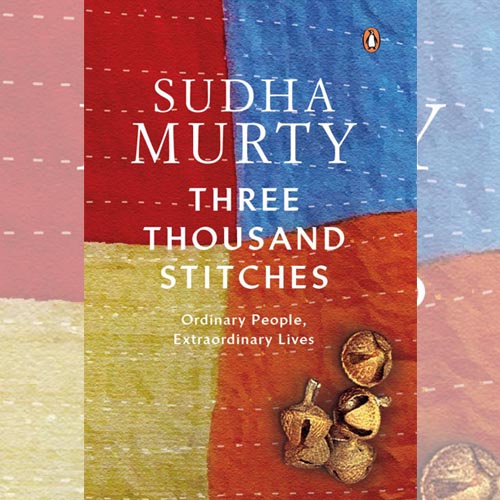
Sudha Murthy: Three Thousand Stitches

shibin

Shibin Dinesh

Program Manager
The book “Three Thousand Stitches” was never in my to-read list and I had purchased this book, just for the sake of qualifying for free shipping on Amazon! However, after reading the book, the Author Sudha Murthy has joined the list of authors whom I follow and would recommend to others as well. Not many may know Sudha Murthy as an author but will ring a bell when you know that she is the spouse of Narayana Murthy, co-founder of Infosys. She has written many books over the years in both English and Kannada and “Three Thousand Stitches” is one of her recent books. Her writing has received critical acclaim over time and she has won a few prestigious literary awards as well. 
 
Coming to the book, “Three Thousand Stitches” consist of a collection of stories, all of which are either the author’s personal stories or her experience on interacting with people from different walks of society. These chapters include details on her childhood and college life, her struggle in succeeding as a woman, family stories, her life at Infosys Foundation and her interaction with many ordinary people that changed her perspective about life. There is no single theme that stitches the chapters together, though one can argue that all the chapters are life lessons!
 
Most of the chapters are intriguing and would leave you wanting to know more though there are few chapters that make you skip the pages or just skim and read. I found the chapters that offer insights on the working of Infosys foundation really interesting as well as the chapter on her college days. On the less interesting side, there are chapters based on stories from Ramayana and Mahabharata, and if you are someone who has heard most of the epic stories earlier, you may feel she could have used these space to tell us more about her personal experience rather than retelling epic stories! 
 
For a reader, the first book you choose of a new author plays a big role in deciding if you are going to follow the author and for me, this book definitely had made an impact after I completed reading. I strongly recommend this book to people of all ages, her language is simple to understand and the content is relevant to children as well as adult readers and would make you reflect yourself on what you have achieved and where you want to go forward!  The book makes the reader realize no matter the circumstances, anything is possible in life and can be achieved if there is a will and passion in what you do. Go ahead and pick this book as your next read!

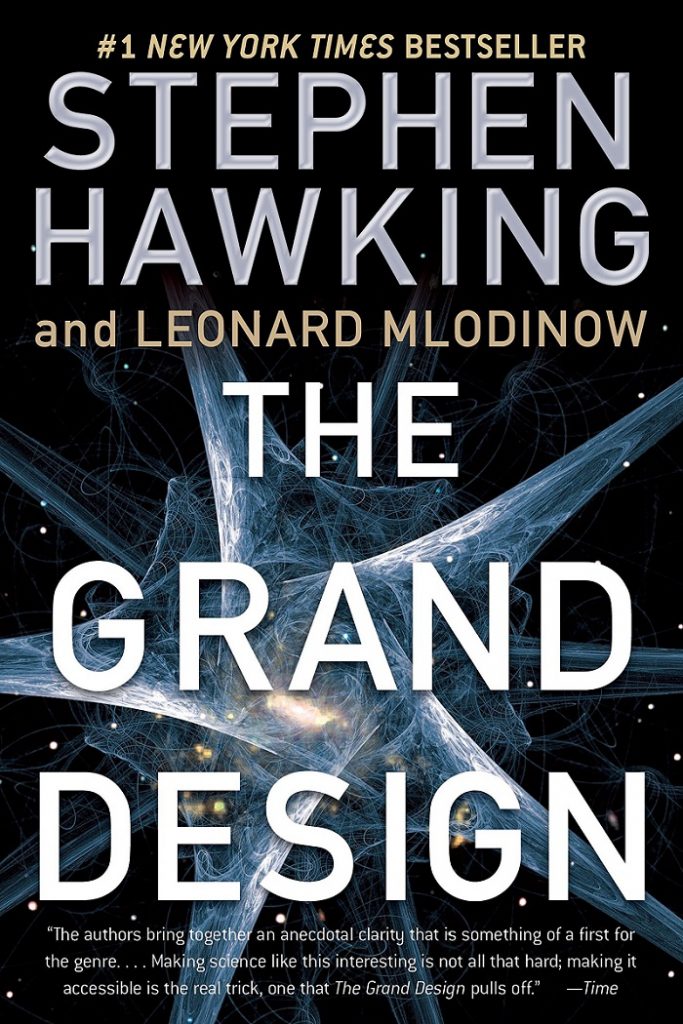
Stephen Hawking: The Grand Design

guru photo

Guruprasad Rao K S

Vice President - Operations

One of my recent reads happened to come from Stephen Hawking, maybe the Amazon bookstore brought them more into the light because of his recent demise. A simple theoretical book for those who wish to know about the existence of life on the planet. More so, it answers questions on why we are here, where did we come from and how we evolved. A debatable concept on the existence of God and the Big Bang theory.

The book relates to some of the good scientific collection of facts about the Ionian Greek groups, a closed group who claimed that everything worked by laws of nature and tried to separate the blind beliefs followed in various religions. Like worshipping of inanimate mountains or substances by ancient men, to finding the real cause for a tsunami or earthquake or solar system or even rains. Scientific evolution claims to be providing more substantial evidence from findings which gradually developed to theories that we proudly believe as scientists.  

Hawking adds his atheist pitch which may or may not be acceptable by many as he purports (as some would understand) that science is the force behind creation. Also, the other interesting facets from the book brings about model-dependent realism (the idea that there is no one version of reality) and about the multiverse concept of reality in which there are many universes. Though the book travels more into quantum physics, Newton’s model that light is a particle in nature, to Einstein’s models that Light has duality and hence it also exists as a waveform. Everything exists in duality and there are theories for everything, and there seems to be a network of theories, which is referred to as the M theory. Each theory within M theory works in a certain range and beyond a certain range when two theories overlap they merge to form a dimension which can describe the framework. Hawking’s cites the concepts of two pebbles striking the water to create overlapping ripples as an example of how different theories came into existence and some may merge to form one or some may not.

A pleasure to read if you always wondered how life came into existence and know a different viewpoint than the religion alone. Questions still tend to be many, like how everything works in the universe in a coordinated manner despite claims of Hawking on individual aspects of Physics and Biology and their convergence to make it sound “No God”. But his views are worth a read, at least to know about some of the greatest minds who contributed to what we are today in science. Most of the true scientists here would appreciate.

A Succinct read and not too much of technical Physics!!